The McEwan Beanie – chunky cable-knit bobble hat, knit flat

So, this is a pattern that I’m really excited to share, because it’s the most complicated one that I’ve created yet.

I went for a run after buying this gorgeous red wool (from Fielders in Wimbledon), and as I was going round I started trying to work out the calculations required to cable and successfully decrease a chunky bobble hat. After a lot of trial and error (and looking strange as I kept stopping to write down notes on my phone), I cracked it.

This bobble hat is knit flat – I wasn’t quite feeling brave enough to throw circular needles into the mix, although that’s next on my list. So if you’ve just learned to cable, this is a surprisingly easy way to put your skills into action.

You will need:

  • 10mm knitting needles
  • 10mm cable needle
  • 1 skein of Rico Essentials Super Super Chunky or a similar super chunky yarn for colour A. For any fellow Londoners, I always buy the Rico (it’s one of my favourites) from the lovely Fielders in Wimbledon – it’s a lovely craft shop, and I always seem to find something I didn’t know I was looking for!
  • A second colour of super chunky yarn (I used the Rico yarn in a navy blue) if you want to do a colour B on the rim. You don’t need much of this, so could be an opportunity to use up leftovers!
  • Yarn needle for sewing up seams
  • Sharp scissors for making your pom-pom

How it’s done:

Cast on 42 stitches in colour B (if using two colours – if not, just stick with the same one throughout)

Rim of the hat – 1×1 rib stitch

Row 1: (K1, P1)

Rows 2-14: Switch to colour A, (K1, P1)

Increase stitches for first round of cabling

Row 15: K1, M1, (P4, K1, M1, K2) 5 times, P4, K2

Row 16: P2 (K4; P4) until 6 before end, K4, P2

Row 17: K2 (P4, K4) until 6 before end, P4, K2

Row 18: P2 (K4; P4) until 6 before end, K4, P2

Row 19: K2 (P4, K4) until 6 before end, P4, K2

Row 20: P2 (C2F, P4) until 6 before end, C2F, P2

Two more rounds of cabling

Row 21: K2 (P4, K4) until 6 before end, P4, K2

Row 22: P2 (K4; P4) until 6 before end, K4, P2

Row 23: K2 (P4, K4) until 6 before end, P4, K2

Row 24: P2 (K4; P4) until 6 before end, K4, P2

Row 25: K2 (P4, K4) until 6 before end, P4, K2

Row 26: P2 (C2F, P4) until 6 before end, C2F, P2

Rows 27-32: Repeat rows 21-26

Decrease for crown:

Row 33: K2tog, (P4, K2tog, K2tog) until 4 stitches before end, P4, K2tog – 36 stitches

Row 34: P1, (K2tog, K2tog, P2) until 5 stitches before end, K2tog, K2tog, P1 – 24 stitches

Row 35: K1, (P2, K2tog) until 3 stitches before end, P2, K1 – 19 stitches

Row 36: P1, (K2tog, P1) until 3 stitches before end, K2tog, P1 – 13 stitches

Row 37: (K1, P1) – 13 stitches

Row 38: P1, (Sl1k) – 7 stitches

Cut your thread leaving approximately 40cm tail, and pull it through the remaining stitches.

Then take your yarn needle, and sew the sides together using mattress stitch. See this link for a helpful tutorial.

You’re then ready to make your bobble. See my Rico Bobbles post for bobble instructions.

Fold over the rim of your hat, and you’re done! Ski style, complete!

For more free knitting patterns and craft inspiration, you can find me on Instagram as @craftitlikekatie – tag me in your makes!

Antique-foiled monogram letters

Starting with a disclaimer – this project was a total steal. To check out the original, take a look at https://www.whatchaworkinon.com/archives/2292

What I can offer you though, is the confidence that anyone can do this! I really wanted to have some nice, rustic monogram letters at our wedding, but I just didn’t want to spend much money on them. Then I saw these on Pinterest, and decided that they looked worth a try…despite one of my bridesmaids warning me that it might not end up quite like the pictures (oh ye of little faith!) And I’m pretty pleased with how they turned out!

So, how is it done? You can of course take a look at the link I shared above…but feel free to keep reading for the dummy’s guide to antique foiling.

What you need:

  1. MDF or wooden letters – mine were the 25cm MDF letters from Hobbycraft, which don’t have the nice weight of wooden, but are very cheap and look exactly the same once they’re covered in foil and glue
  2. A pencil for drawing your pattern
  3. Tacky glue – this is your artistic medium for this challenge, so get ready to start swirling.
  4. Tin foil – the basic stuff is fine, just make sure it doesn’t have ‘Bacofoil’ or something similar imprinted all over it – this may happen if you don’t check, and it’s not the look you want
  5. Decoupage glue – here I discovered Mod Podge for the first time. I went for the basic matt one, but you can also go wild with glitter types etc. if you’re so inclined
  6. Shoe polish – I did a mixture of brown and black (largely because we had both), but you could opt for just the one
  7. A sponge or soft cloth to apply said shoe polish

How it’s done:

  • Take your MDF letter, and draw your pattern onto it in pencil. Remember that you’re going to need to shape the foil round the pattern once it’s risen with the glue, so leave a bit of space between the swirls and dots (or whatever design you choose)
  • Once you’re happy with your pattern, go over it with your tacky glue. You may want to do a second later once the first has dried, to make it more pronounced. This is an overnight job, so it’s probable that whoever you live with will come and ask what’s going on when they see these strange letters drying all over the kitchen
    Cover your letter with Mod Podge glue. Then, cut out a piece of foil in the shape of your letter, plus about half an inch extra. Press this down onto your letter, and mould round the edges, making tears if you need to. If you have holes in your letters, cut slits in the holes up to each corners and fold your foil over the sides
    Massage down the foil into the shapes made by your swirls, until you can see the pattern through
    At this point, your edges are likely to look a bit messy. Cut strips of foil that are the width of your edges, and glue these round. You can also foil the back of the letters if they’re going to be showing.
    Now for the fun bit – get your shoe polish, and squeeze onto a soft cloth (the type used for dusting is ideal). You can use brown, black, or a combination of both. Keep dabbing it on until you’re happy with the level of tarnish
    Coat with a layer of Mod Podge to seal your design, and let dry. I completed this step a couple of times to make the letters really strong, adding extra shoe polish each time

And your letters are ready! I added picture hooks onto the back of mine to hang them, but they can also lean against things.

I’m already trying to think of new ways that this tacky glue/Mod Podge/foil combination could be used for other crafts – if you have any ideas, let me know!

Chunky cable-knit headband

Headbands are a great way to venture into cable-knitting – and these chunky ones only take a few hours to make.

This one was made for my Mum, who wanted something to keep her ears warm during her Saturday morning ParkRuns. She happens to be something of a diva when it comes to wool softness, so pretty much everything that I make for her uses Knitcraft’s Funky Chunky Yarn – it’s 100% acrylic, very easy on sensitive skin, and even better, it’s easy on the wallet too.

The pattern that I’ve used is a simple cable knit – if you want to make the headband thicker, you can add on extra stitches to the ribbing before and after the cable.

What you need:

  • A skein of Knitcraft Funky Chunky Yarn, or other super chunky yarn
  • 9mm needles (mine were straight, but you could go circular if you prefer)
  • A cable needle

  • A yarn needle for seaming

How you do it:

  • Cast on 12 stitches
  • Row 1: K3, P6, K3
  • Row 2: K12
  • Row 3: K3, P6, K3
  • Row 4: K12
  • Row 5: K3, P6, K3
  • Row 6: K3, Cable 3 Front, K3 (for a more detailed description of how to cable, see Wool and the Gang’s video tutorial)
  • Repeat rows 1-6 until your headband fits comfortably round your head – mine needed 12 repetitions
  • Cast off
  • Use your yarn needle to bind your seams together

And there you have it – super easy, and perfect for the ski slopes, running, or just keeping your ears a bit warmer on the way to work (probably not one for the tube). You can also see below another one in the same pattern that I made for my friend Akansha (please ignore my weird post-running face!) in pinks and greys.

Christmas carol hoop decorations

These are a total idea steal from This Hand Painted Home – so if you actually want to buy the pro versions of these, check out their Etsy page. To discover how you can make some slightly less pro versions, read on!

So, I saw these on Instagram, and was inspired to try them out as a Christmas project for my friends at choir (shameless plug to check out Singularity West London Voices on Facebook if you’re chorally inclined). And whilst not quite as polished as the originals, they look really pretty!

Note – whilst this isn’t tricky, there is a lot of drying and waiting to do, so allow a bit of time to make these!

What you need:

  • Wooden embroidery hoops – 10cm or 12cm work well (mine came from John Lewis’ haberdashery section)
  • Printed sheet music for your favourite carols (normal paper is fine)
  • Card – I used Hobbycraft Kraft Card
  • Decoupage paper or paint (optional) to decorate the back of the card
  • Teabags (as I’m married to a Yorkshireman, I’ll advocate for Yorkshire Gold. It makes no difference to the paper-staining.)
  • Paint for the hoops – I already had some gold leaf paint, so I used this. Mine was C Roberson Liquid Metal from Cass Art
  • Decoupage glue – I used Mod Podge Matt
  • Artificial or real greenery (I took some small leaf stems off some flowers I had)
  • String or ribbon

How it’s done:

  • Paint your embroidery hoops on both sides – you’ll need to do this in two phases to let the first side dry before you do the second
  • Cut out your sheet music and the card in a circle shape that’s marginally smaller than the outside of your hoop, but bigger than the inside ring
  • Stick the sheet music circle onto the card circle
  • Make a cup of tea, and take out the teabag (the tea is perfectly fit for drinking, hence the Yorkshire Gold recommendation). Squeeze out your teabag, and then dab it on your sheet music circle to create an ‘aged’ effect – you may remember doing this in primary school! Make sure the teabag isn’t too wet, or things could start getting soggy at this point
  • Once your tea-stained music circle is dry, cover the front with a layer of Mod Podge, and press the embroidery hoop on top

  • You may want to do a second round of Mod Podge on the front once dry. After this, you can turn your attentions to the back. If your card circle is nice and neat, you may want to leave as is – if so, just cover this in Mod Podge and let dry. Mine was not, so I made another (better) circle in decoupage paper, and stuck this on top before sealing with the glue. You could also use paint if you prefer
  • While you’re waiting for this all to dry (I told you there was a lot of drying), you can prepare your leaves. If they’re artificial, skip this step – but if they’re real, just give them a coat of Mod Podge to seal them

  • After everything’s dry, glue the leaves to the top of the ring, so that they fan out over the sides
  • Then, take your string and tie it in a loop (big enough to hang) with c.10cm left hanging down on each side. If your embroidery hoop has something to attach to at the top, thread it through this). Tie the loose ends into a bow, and trim as needed. If you didn’t already loop the string through the hoop, just glue it on, with the ribbon covering the start of the greenery stems

And (after a final stint of drying), you’re done! There’s lots of scope to customise these to your own taste – different paint, quotes instead of sheet music, or other decorations on top – so let your creative side run wild. Or, just copy somebody else like I did.

Good luck, and send me any pictures if you try it yourself (I might just copy those too!)

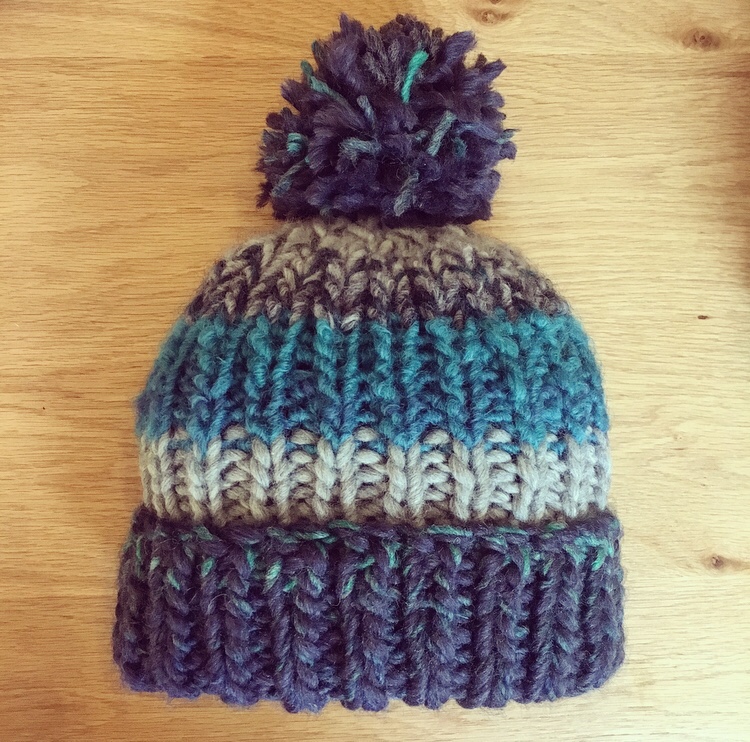
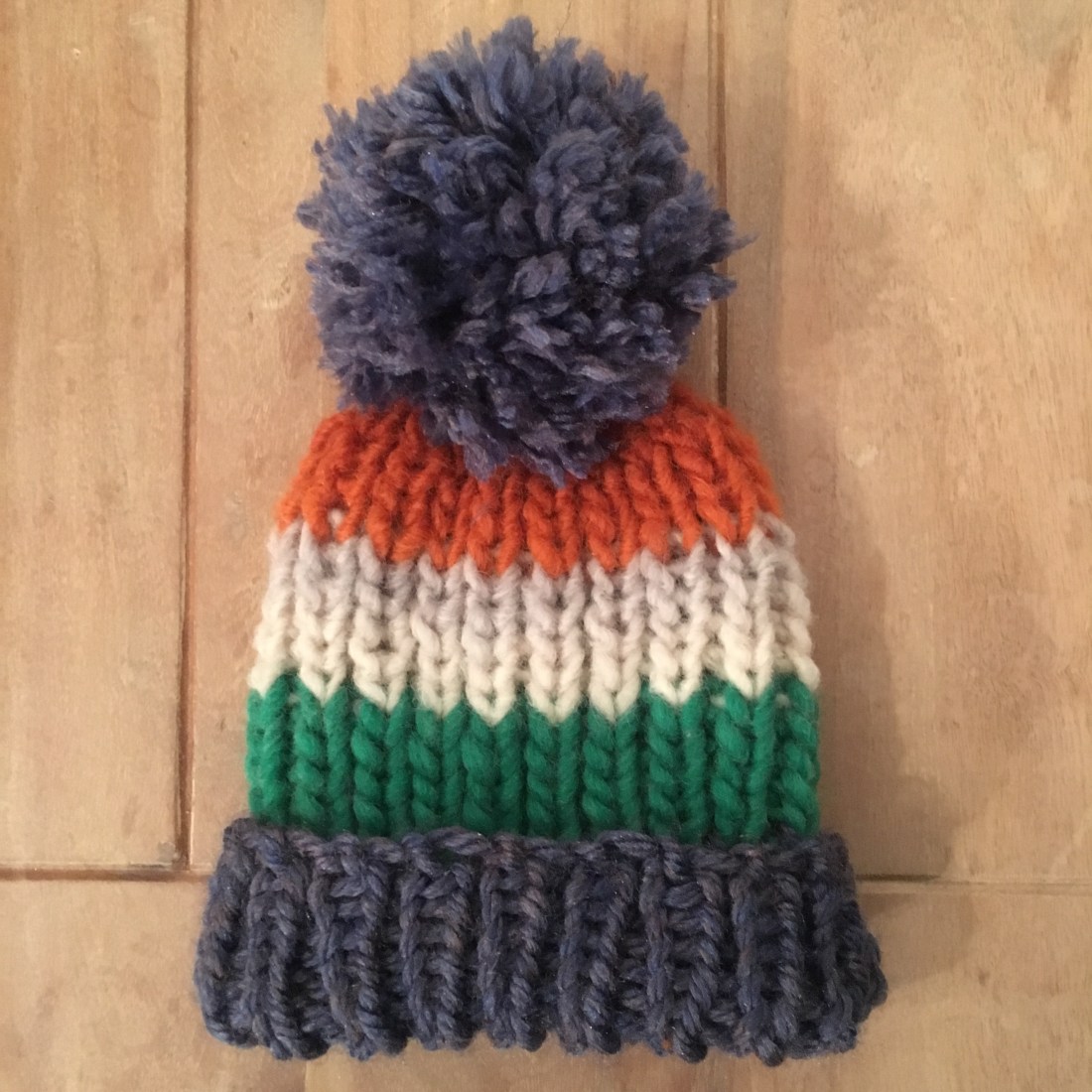
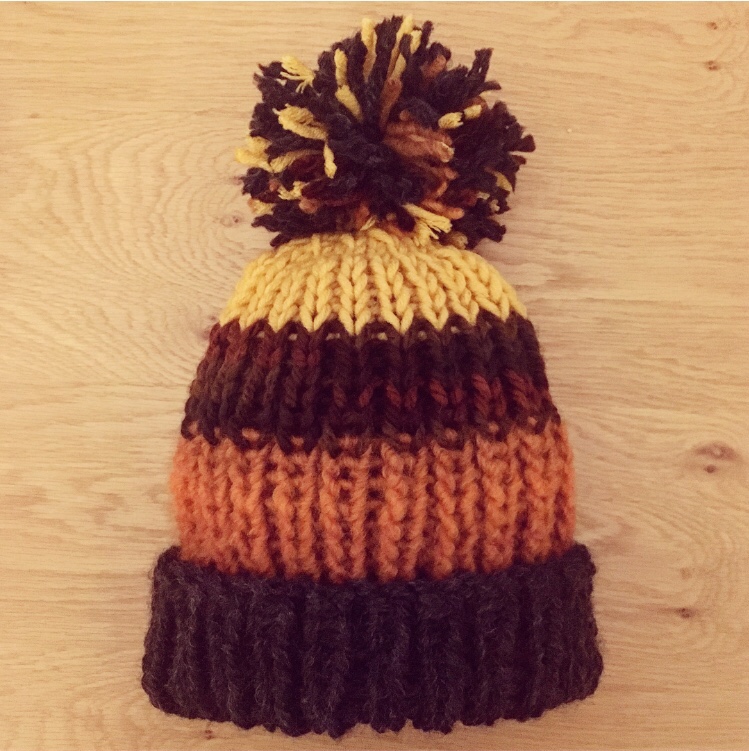
The Hardy Beanie – ribbed pattern adult bobble hat

I’ve just started knitting bobble hats on commission to raise money for my friend Harriet’s amazing Moldova project charity (see https://themoldovaproject.com/ if you’d like to know a bit more about them). Cue lots of new wool, experimental colour schemes, and different patterns. I think I might be close to becoming crazy bobble hat lady…

So this hat is different to ones that I’ve done before in that it folds over at the bottom, and keeps the 1×1 rib pattern going all the way to the top. This created a small amount of panic when I realised that I didn’t know how to decrease in rib, but after a bit of research, a solution was found (welcome to my new technique, slip/slip/knit!)

Here goes with the pattern…

Needles: 10mm straight knitting needles, plus yarn needle for sewing up at the end

Yarn: I used Rico Creative Twist Super Chunky in navy and silver grey (link here) and Rico Creative Melange Big in multi nature and teal-aqua (link here). Depending on how often you swap colours, you’ll need just over one skein in total.

Directions:

Cast on 46 stitches in your first colour

Rows 1-16: (K1, P1) – ribbed pattern

Rows 17-22: change to second colour, (K1, P1) – ribbed pattern

Rows 23-28: change to third colour (K1, P1) – ribbed pattern

Rows 29-32: change to fourth colour (K1, P1) – ribbed pattern

Row 33: stay with fourth colour, and start to decrease (SSK) to end – 23 stitches (if, like me, you’ve never tried SSK before, see here for a simple video tutorial that I followed)

Row 34: (P1) all the way

Row 35: K1, (SSK) to end – 12 stitches

Row 36: (P1) all the way

Row 37: (SSK) to end – 6 stitches

Cut your thread leaving approximately 40cm tail, and pull it through the remaining stitches.

Then take your yarn needle, and sew the sides together using mattress stitch. I swapped yarn quite frequently here to make sure that the shades matched.

You’re then ready to make your bobble – I went back to my first colour for this. See my Rico Bobbles post for bobble instructions.

Fold over the rim of your hat, and you’re ready to face the winter. I’m almost tempted to keep this one for myself!

For more free knitting patterns and craft inspiration, you can find me on Instagram as @craftitlikekatie – tag me in your makes!